My Father & The 5th Armored Division

Part 3: Germany- Manschau & The Hurtgen Forest

SIGFRIED TO HURTGEN ROUTS

Page 25

TO MONSCHAU & THE HURTGEN FOREST

September 23 – November 30, 1944

After retreating from the Wallendorf area the 5th Division settled down in the Diekirch area; its activities during the remainder of September were restricted to patrolling the border from Rodershausen on the north to Bollendorf, which is four miles south of Wallendorf. Fifth Armored men knew for certain that they were in for a winter campaign when, on 28 September, a convoy of 80 trucks left on the long trip to Normandy to pick up the duffel bags which contained each man’s winter clothing.

On October 3, 1944 the Fifth Armored then rolled north about 40 miles to the Faymonville-Waimes-Butgenbach area in Belgium.

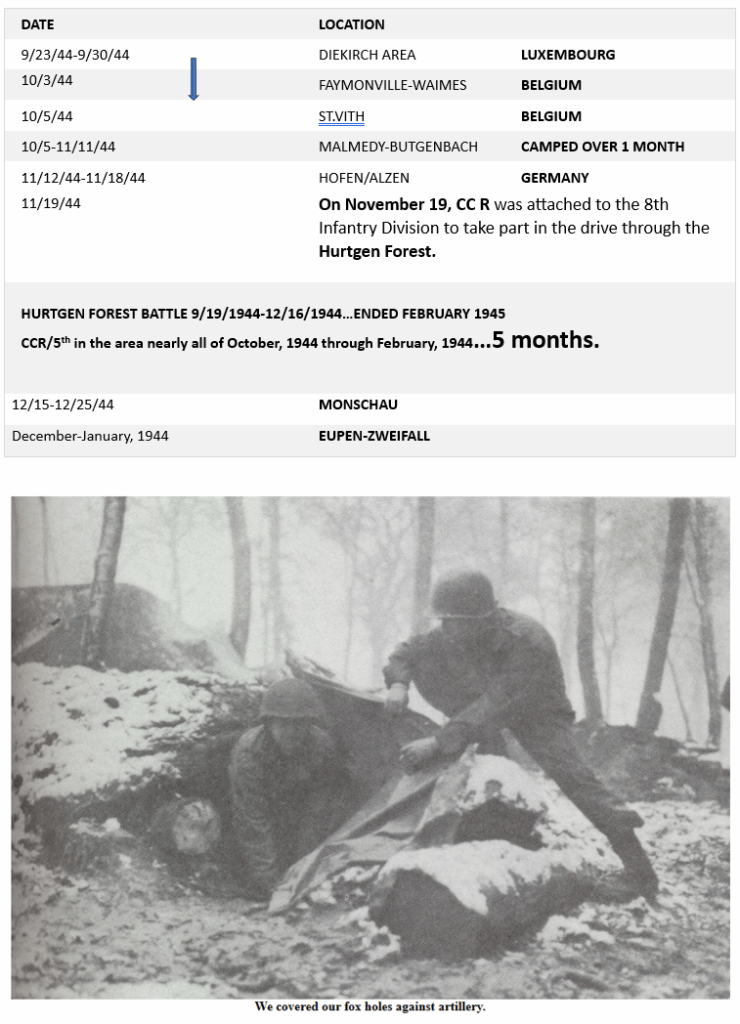
On October 23rd, CC R’s 47Th Infantry Bn. moved into the 5,000-yard front and set up 27 observation posts. On November 19, CC R was attached to the 8th Infantry Division to take part in the drive through the Hurtgen Forest. 
Hurtgen Forest to The Roer River
24 November-24 December

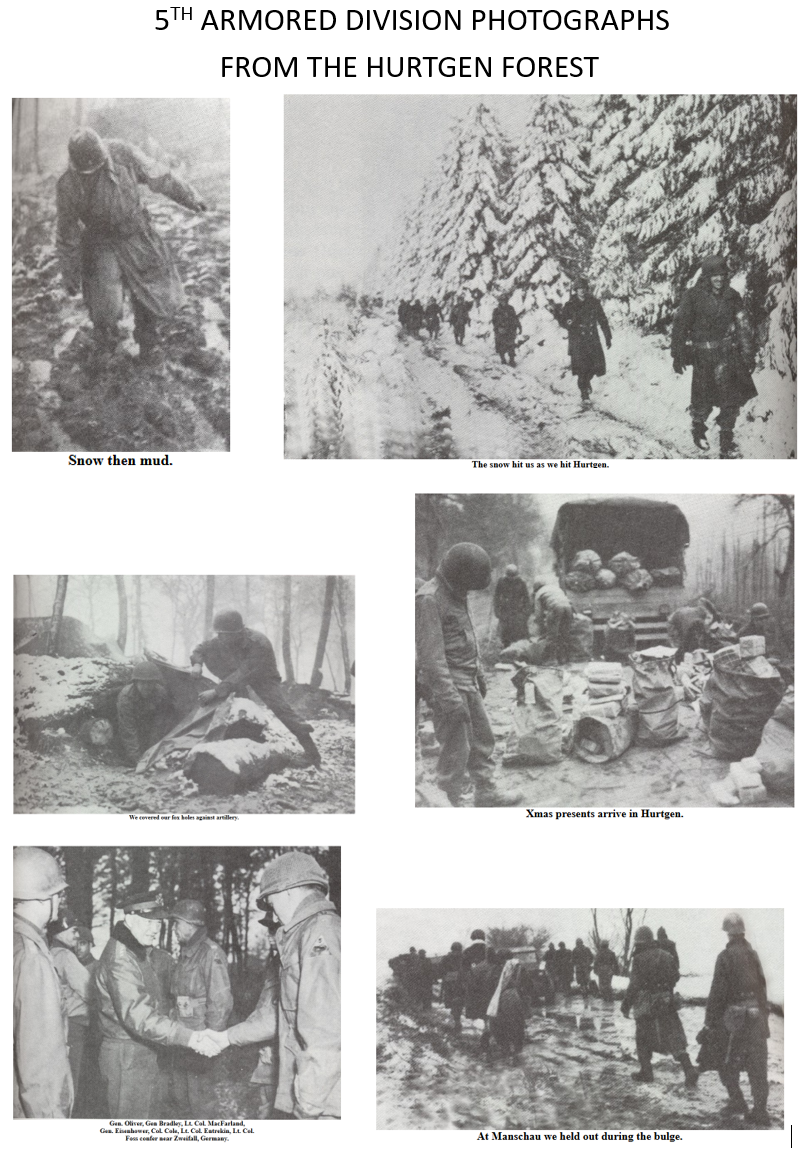
JeepGeneral Dwight D. Eisenhower said that veterans who participated in the Battle of the Hurtgen Forest place that struggle at the top of their list of hard fighting. Without hesitation men of the Fifth Armored put that ordeal at the head of their list. The month in the Hurtgen Forest was the darkest period in the division’s combat history.

In this dense and somber forest of pine, men battled snow and mud and frigid weather as well as an entrenched and fiercely resolute enemy, were prevented from maneuvering or deploying by the trees, the mud, the ravines and the extensive mine fields. Advances, therefore, had to be made in bitter yard-by-yard struggles against the well-placed Germans who fought here with savage tenacity. The attackers were subjected to tremendous concentrations of artillery and mortar fire directed from observation posts on high ground, across the Roer River. Foxholes offered little protection since the shells burst in the tree tops and sprayed the ground below with their fragments.

Page 26

After each long, miserable and sleepless night spent in the icy foxholes, men numb from the cold climbed out at dawn to begin another attack. As they pushed forward through the thickly sown mine fields, the bursting shells and sniper fire, they watched their numbers dwindle. Each gain of a few yards exacted a frightful price in dead and wounded. And to the collecting stations in the rear flowed the heartbreaking procession of the wounded, some walking and the others on litters.
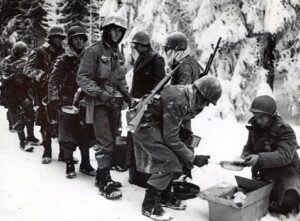
BreakfastThe night of 24 November, 1944, was cold, black and rainy. Combat Command R started into the Hurtgen Forest. The mission was to take the German town of Hurtgen. The 95th Armored Field Artillery Bn. had gone into position five days earlier. First company to move was B Co. of the 47th Armored Infantry Bn., The infantrymen moved out of Rotgen in their halftracks, leaving their married B Co. of the 10th Tank Bn, behind, Too great a concentration of armor, it was felt, would attract heavy artillery fire. The Germans had sown the area heavily with schu and anti-personnel mines and almost immediately explosions and cries for “Medics!” filled the forest. At dawn the Germans began to pour in more and more artillery. Small arms fire increased. Casualties skyrocketed, and when the tanks arrived at the jump-off point at their scheduled time, 0730, the infantry company was badly battered.

The battle raged on for weeks. The rest of the story will be told by our Hurtgen Forest Tour Guide.

 Estimated Total Casualties – Hürtgen Forest

Side

Total Casualties

  Killed

Wounded

Missing / Captured

United States

33,000–55,000

 12,000

 24,000

        9,000

Germany

28,000–35,000

 12,000

 20,000

        3,000

Page 27

BATTLE OF THE BULDGE

Just a few miles south of the Fifth Armored’s positions the Germans launched more than 400,000 personnel, more than 1,400 tanks and armored vehicles, 2,600 pieces of artillery, and more than 1,000 combat aircraft directly at a 75-mile (120 km) stretch of the front in the Ardennes in an offensive designed to punch through the Allied lines.

Meanwhile, the Fifth Armored’s combat commands to be committed in the Hurtgen struggle was CC R; it pushed toward the town of Hurtgen and then took Kleinhau, Brandenberg, and Bergstein. Near the end of November CC A entered the fray a little further to the north and nearer to the Roer River; it attacked through Gey, Horm and Kufferath to the banks of the river. CC B, which came into the fight in early December, also made for the river; it attacked through the towns of Langenbroich, Bergheim and Bilstein. After it completed its mission in the Hurtgen Forest, the Fifth Armored was pulled back into Belgium to help block the Germans’ drive toward Liege during the Battle of the Bulge.

The 5th Armored Division, including its Combat Command Reserve (CCR), played a key supporting and flanking role during the Battle of the Bulge (Dec 16, 1944 – Jan 25, 1945), though it was not in the direct path of the initial German offensive. Here’s a breakdown of their involvement:

 Context Before the Bulge:
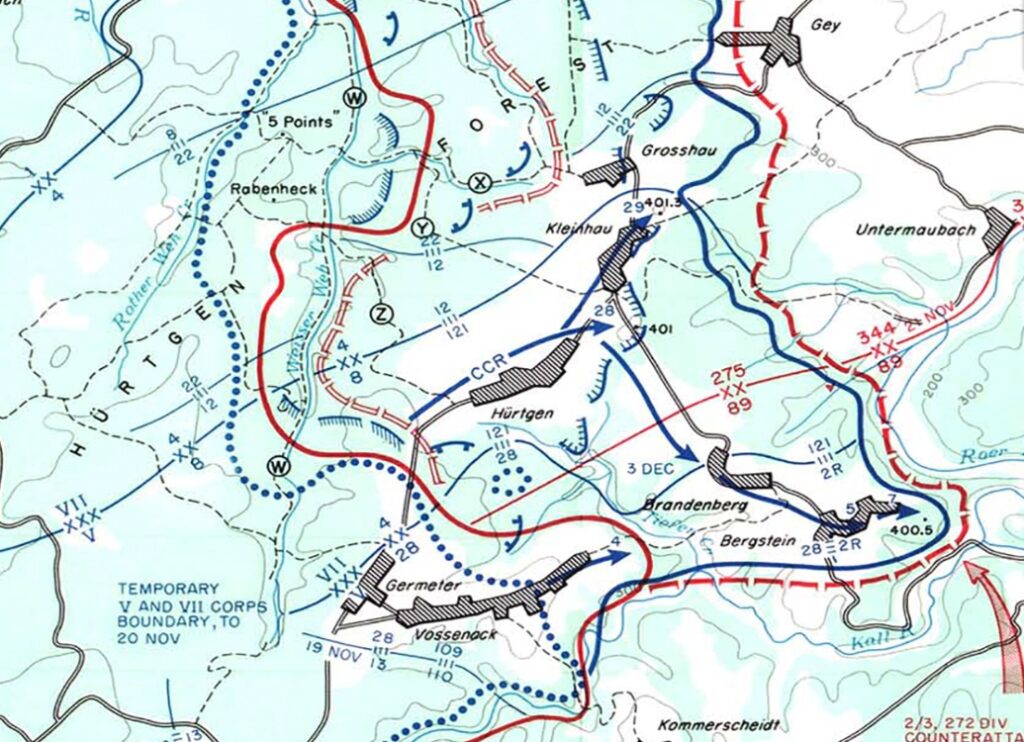
  • In December 1944, the 5th Armored Division had recently completed action in the Hürtgen Forest area, especially near Zweifall, Stolberg, and Vossenack.
  • CCR had been operating east of these towns, engaging in clearing operations, defensive holding, and patrolling in the rugged terrain on the German border.

battle of the buldge

While the Fifth Armored was fighting its way through the Hurtgen Forest and across the approaches to the Roer River, the Germans on 16 December began their last desperate attempt to attain victory on the Western Front.
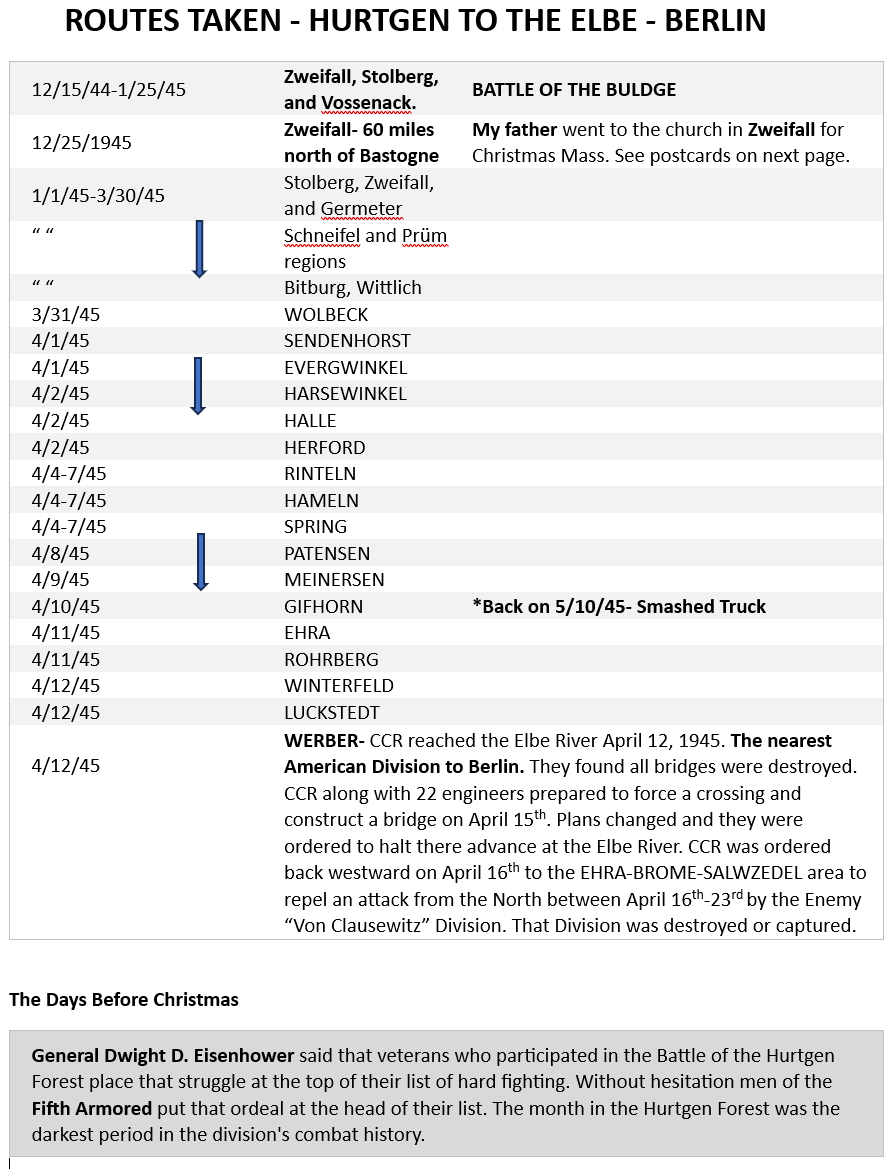
Page 27 B

Page 28

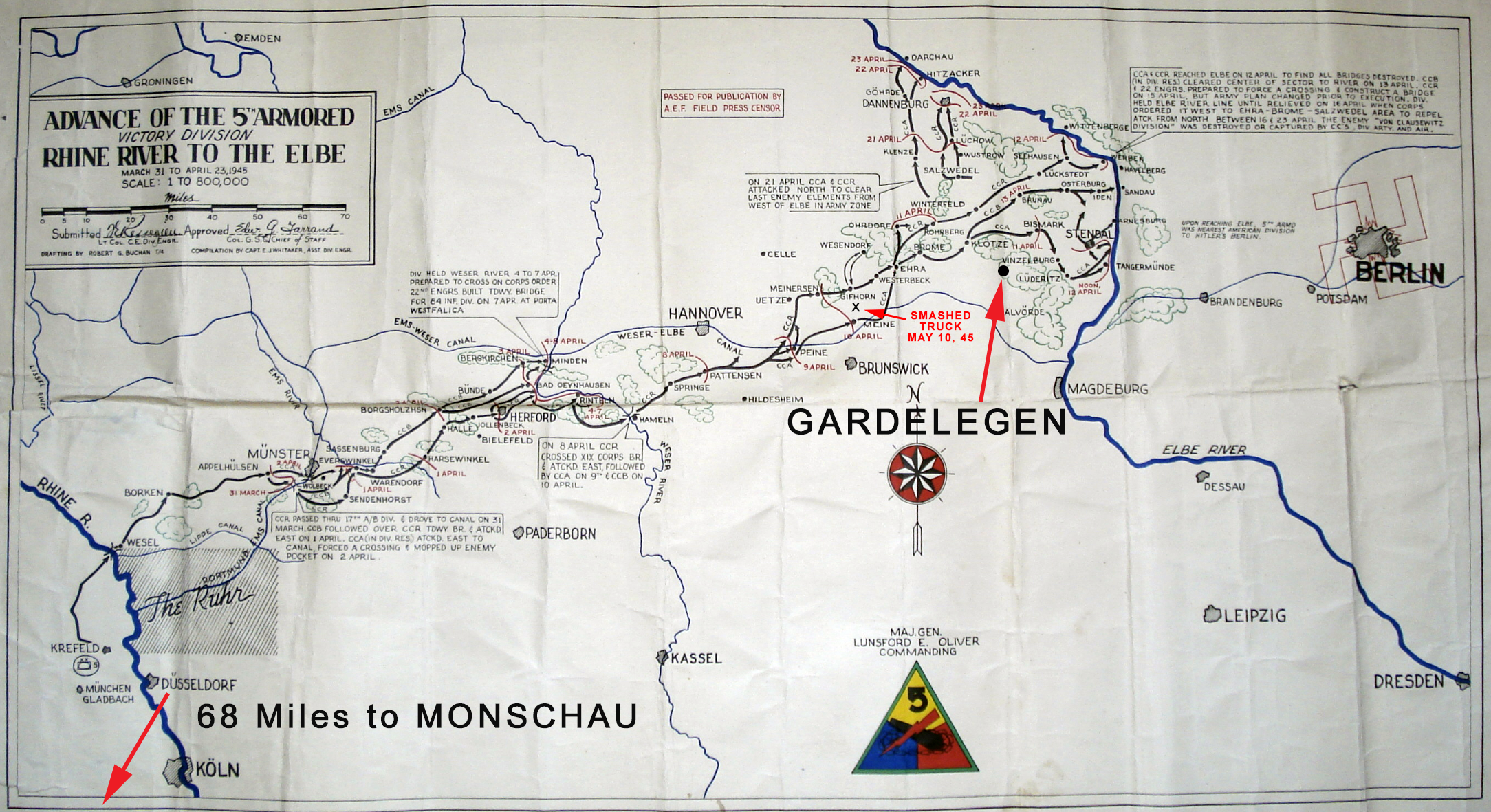
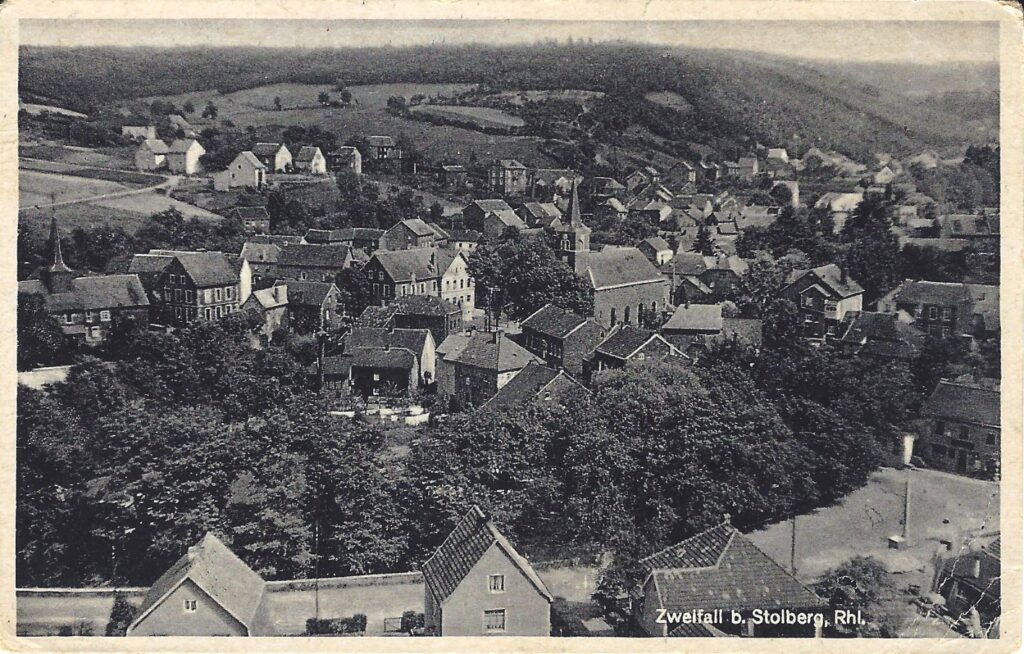
The post card below was sent in July 10, 1945, 2 months after my father “SMASHED HIS TRUCK” outside of GIFHORN, GERMANY. The war in Europe was over. This is the town of ZWEIFALL, population of around 900. My father went to Mass at the church pictured on the postcard on Christmas Day 1944.

Zweifell Postcard

Most of the correspondence between my father and his parents was in Lithuanian. Luckily this time he used English. Here is his message.
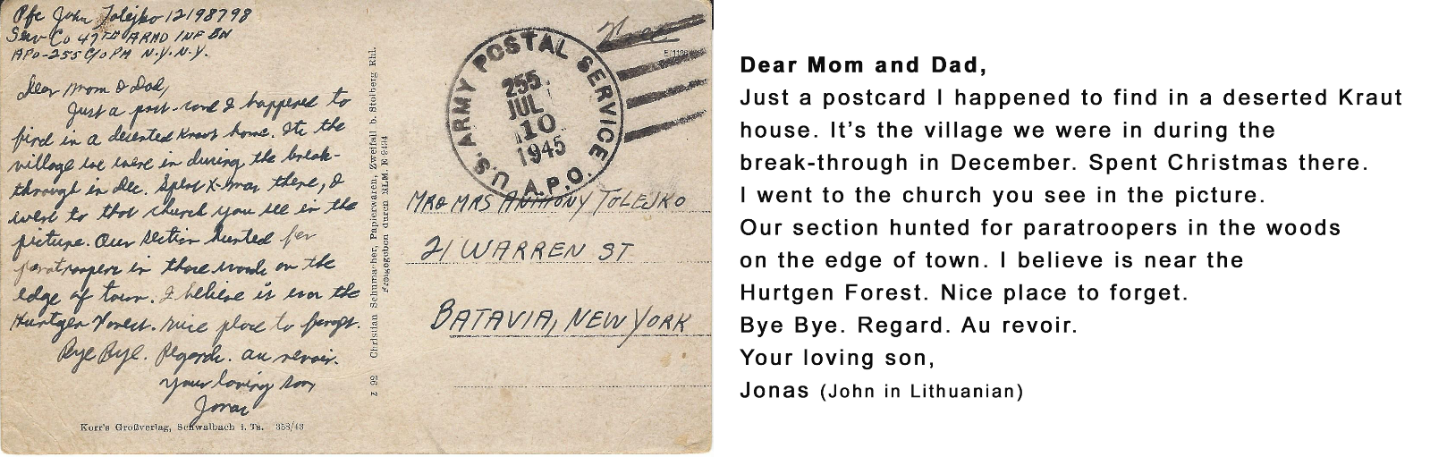
postcard to parents

Page 29

Page 30

Page 31

GARDELEGEN MASSACRE

In 1945, as Allied troops penetrated Nazi Germany, the SS began evacuating prisoners from concentration camps in outlying areas on death marches to the interior of the Reich. It was part of a desperate and hopeless effort to keep the war effort going and to prevent the inmates from falling into enemy hands, where they could testify against their persecutors.

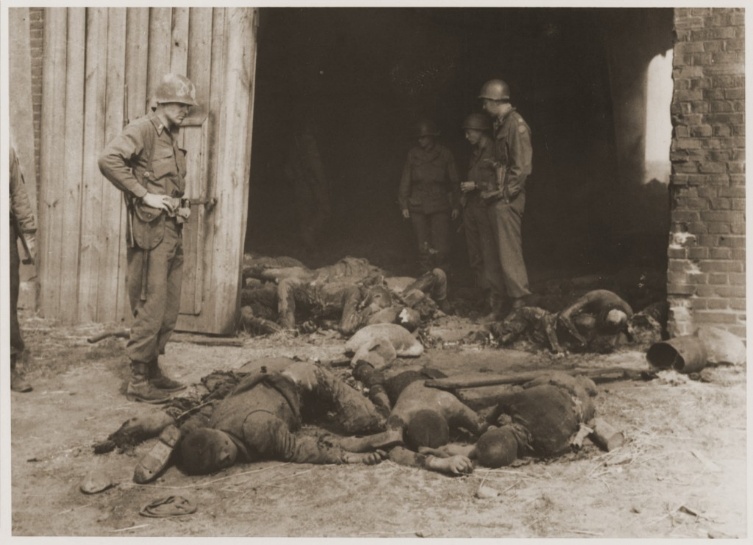
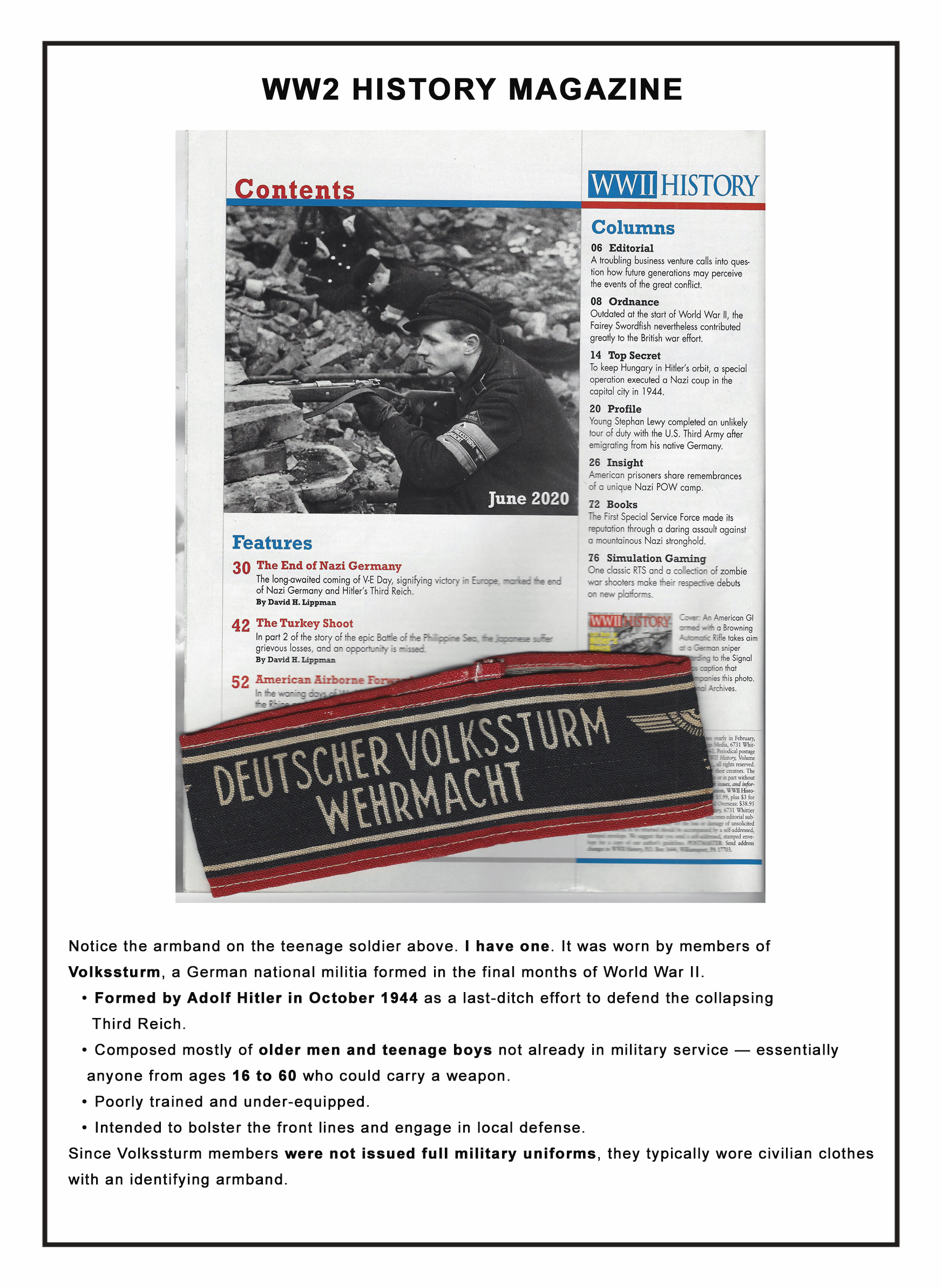
Following the US Army’s crossing of the Rhine River and push into central Germany, the SS camp administration at Dora-Mittelbau ordered the evacuation of prisoners from the main camp and a number of its affiliated subcamps on April 3 and 4th. The goal was to transport the inmates by train or by foot to the concentration camps in Bergen-Belsen, Sachsenhausen, or Neuengamme. Within days, some 4,000 prisoners from Dora-Mittelbau, its satellite camps, and a Neuengamme subcamp arrived in the Gardelegen area. Greatly outnumbered by the prisoners, the SS guards began recruiting auxiliary forces from the local fire department, the air force, the aged home guard, the Hitler Youth, and other organizations to watch over the inmates. On April 13th, more than a thousand prisoners, many of them sick and too weak to march any further, were taken from the town of Gardelegen to a large barn on the Isenschnibbe estate and forced inside the building. The assembled guards then barricaded the doors and set fire to gasoline-soaked straw.

Those attempting to escape were killed by the guards. The next day, the SS and local auxiliaries returned to dispose of the evidence of their crime. However, the swift advance of the 102nd Infantry Division (part of the 5th Armored Division) prevented the SS and its accomplices from completely carrying out this plan.

On April 14th, the 102nd entered Gardelegen and, the following day, discovered the atrocity. They found the corpses of 1,016 prisoners in the still-smoldering barn and nearby trenches. They also interviewed several of the 11 prisoners that survived.

On April 21, 1945, the local commander of the 102nd ordered between 200 and 300 men from the town of Gardelegen to give the murdered prisoners a proper burial. Over the next few days, the German civilians exhumed 586 bodies from the trenches and recovered 430 bodies from the barn, placing each in an individual grave. On April 25, the 102nd carried out a ceremony to honor the dead and erected a memorial tablet to the victims, which stated that the townspeople of Gardelegen are charged with the responsibility that the “graves are forever kept as green as the memory of these unfortunates will be kept in the hearts of freedom-loving men everywhere.” Also on April 25, Colonel George Lynch addressed German civilians at Gardelegen with the following statement:

“The German people have been told that stories of German atrocities were Allied propaganda. Here, you can see for yourself. Some will say that the Nazis were responsible for this crime. Others will point to the Gestapo. The responsibility rests with neither — it is the responsibility of the German people….Your so-called Master Race has demonstrated that it is master only of crime, cruelty and sadism. You have lost the respect of the civilized world.”

Page 32

gardelegan bodies

Within days, US Army Signal Corps photographers arrived to document the Nazi crime and by April 19, 1945, the story of the Gardelegen massacre began appearing in the western press. On that day, both the New York Times and The Washington Post ran stories on the massacre, quoting one American soldier who stated: “I never was so sure before of exactly what I was fighting for. Before this you would have said those stories were propaganda, but now you know they weren’t. There are the bodies and all those guys are dead.”
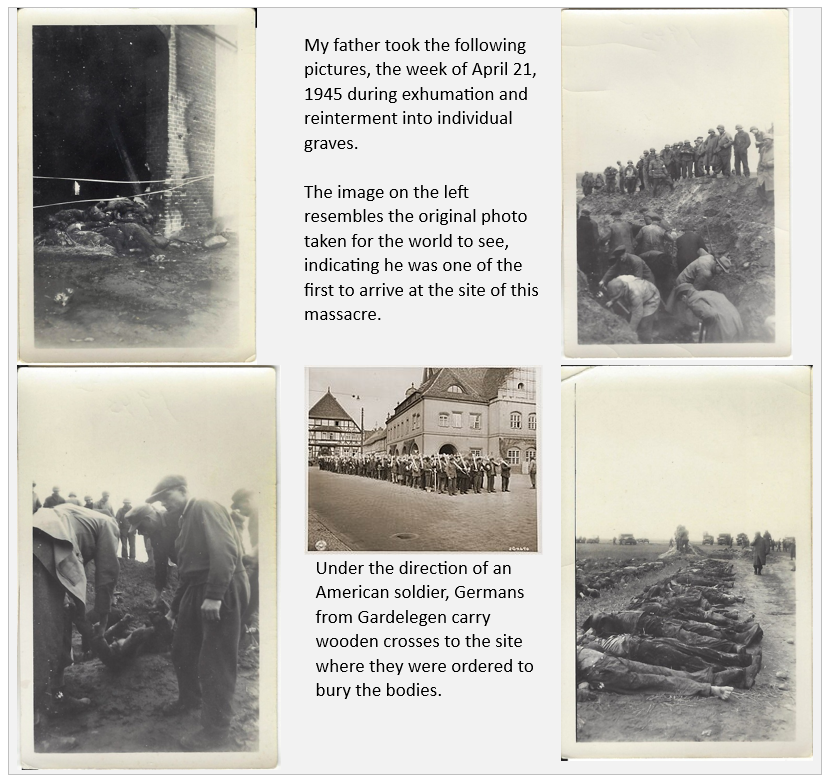
gardelegen images

Page 33

THE 5TH ARMORED DIVISION ACTIVITIES

JANUARY-MAY 1945

During January, February, and March 1945, the 5th Armored Division, and specifically Combat Command Reserve (CCR), operated in Luxembourg, Belgium, and western Germany, as part of the U.S. push toward the Rhine after repelling the German Ardennes Offensive (Battle of the Bulge).

January 1945

  • Early January:
    The 5th Armored Division was helping to contain and repel the northern shoulder of the German counteroffensive (Battle of the Bulge). CCR was in the Zweifall-Hürtgen area, northeast of the Bulge, engaged in defensive and limited offensive actions.
    • They secured forested and mountainous terrain between Stolberg, Zweifall, and Germeter, continuing patrols and holding lines against German forces.
  • Mid-to-late January:
    The division moved eastward as the Germans retreated. The 5th Armored began clearing villages and pressing into the Siegfried Line (Westwall) defenses in western Germany.

February 1945

  • The division, including CCR, was involved in clearing the Westwall fortifications and conducting aggressive reconnaissance.
  • They operated in the Schneifel and Prüm regions, pushing toward the Rhine River through the Eifel Mountains.
  • CCR likely spearheaded combined arms attacks, capturing towns and destroying bunkers.
  • The terrain was difficult: forests, cold, snow, and blown bridges made progress slow. Artillery duels and minefields were common.
  • Troops faced heavy resistance in Prüm (cleared mid-February), and prepared to cross into more open terrain beyond the mountains.

March 1945

  • The division advanced rapidly across the Rhineland, clearing towns west of the Rhine.
  • CCR played a key role in mobile operations, exploiting gaps and capturing German units.
  • They moved through Bitburg, Wittlich, and toward the Moselle River.
  • By mid-March, 5th Armored had reached the Rhine River, north of Koblenz, but did not cross immediately (crossings were assigned to other divisions, such as the 9th Armored at Remagen).
  • The division was repositioned slightly northward, preparing for the Ruhr Pocket campaign, which would start in April.               

Page 34

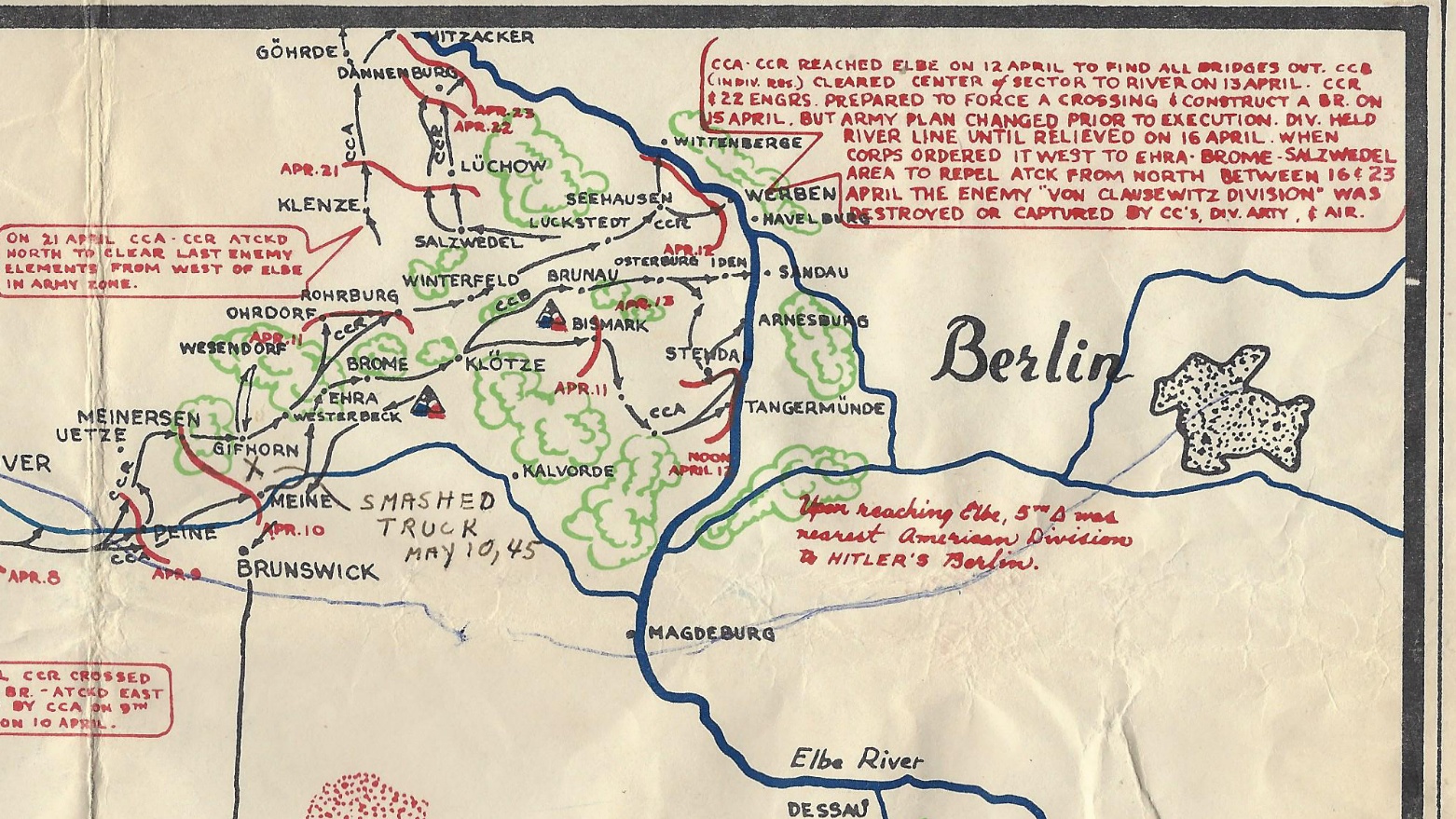
In April 1945, the 5th Armored Division, including Combat Command R (CCR), was conducting one of the fastest advances by any U.S. division in World War II. They were racing across central Germany, liberating towns, cutting German supply and communication lines, and pushing rapidly toward the Elbe River, west of Berlin.

🔹 Early April (April 1–10):

  • Crossed the Weser River and captured towns like Helmstedt and Brunswick (Braunschweig).
  • CCR was often on the flanks or in the rear for mop-up and security, as well as protecting supply lines.
  • Units pushed through Magdeburg (north of Leipzig) and advanced toward the Elbe River.
  • The division covered over 300 miles in about 8 days during this phase.

🔹 Mid-April (April 11–15):

  • Reached the Elbe River near Tangerhütte and Stendal, becoming one of the first American units to do so.
  • On April 12, elements of the division made first contact with the Soviet Red Army at the Elbe.
  • Around April 13–15, CCR was involved in liberating Gardelegen, where they discovered the aftermath of the Gardelegen massacre — the murder of over 1,000 concentration camp prisoners by the SS and local Volkssturm.

Page 35

  • CCR secured the town and supervised the forcible reburial of the victims by the local German population.


🔹 Late April (April 16–30):

  • After contact with the Soviets, the 5th Armored was ordered to halt its advance.
  • They shifted to security, occupation, and clearing operations in the area between Gardelegen, Stendal, and the Elbe River.
  • CCR helped:
    • Manage POWs and refugees,
    • Provide civil affairs oversight in occupied towns,
    • Secure bridges, roads, and depots in preparation for postwar duties.

Page 36

Page 37

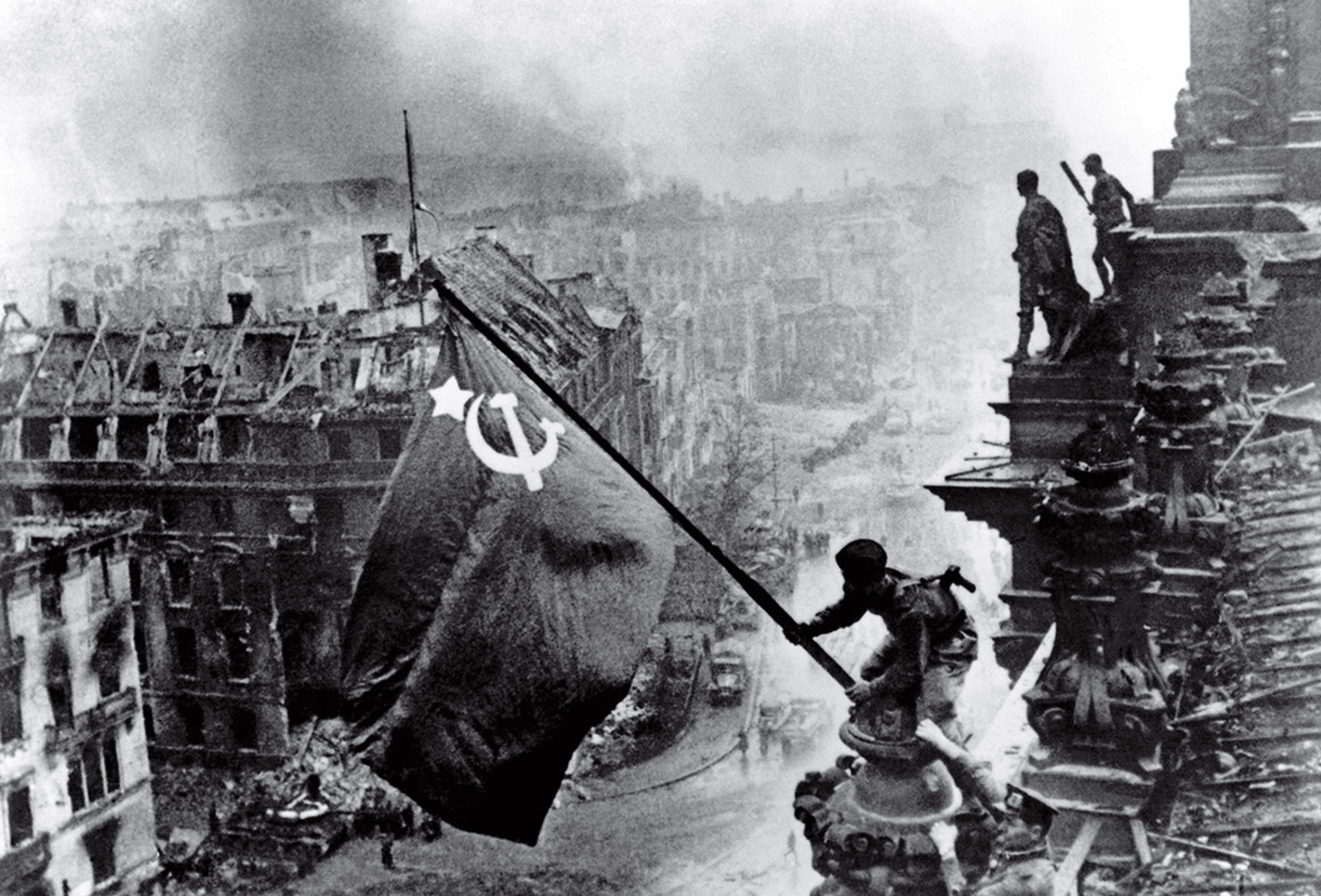
THE BATTLE OF BERLIN

The Battle of Berlin, a decisive engagement in World War II, unfolded from April 16 to May 2, 1945. Soviet forces, beginning the final offensive on April 16th, gradually took control of the city. The city’s garrison surrendered on May 2nd, marking a significant blow to Nazi Germany. 

The U.S. 5th Armored Division was the closest American unit to Berlin at that point—within about 50 miles—but U.S. policy had already agreed to let the Soviets take Berlin to avoid unnecessary Allied casualties and political conflict. U.S. President Franklin Roosevelt was not interested in conquering Berlin. He wanted the Soviet Union as an ally in the war against Japan, and above all as a partner in the creation of a stable post-war world order.

On 16 April 1945, the Soviet forces started the final offensive against the German capital. They tried to encircle Berlin in a pincer movement. But the attempted fast breakthrough into Berlin did not materialize. Instead, it took them four days and many casualties to get past the Seelow Heights, situated about 70 km east of Berlin.

On 21 April, the first Soviet units finally entered Berlin. In house-to-house fighting the Soviet soldiers faced desperate German resistance. The Western Allies stopped their air attacks on 16 April 1945. The Soviet Union continued the air war to support the ground offensive in Berlin.

Page 38

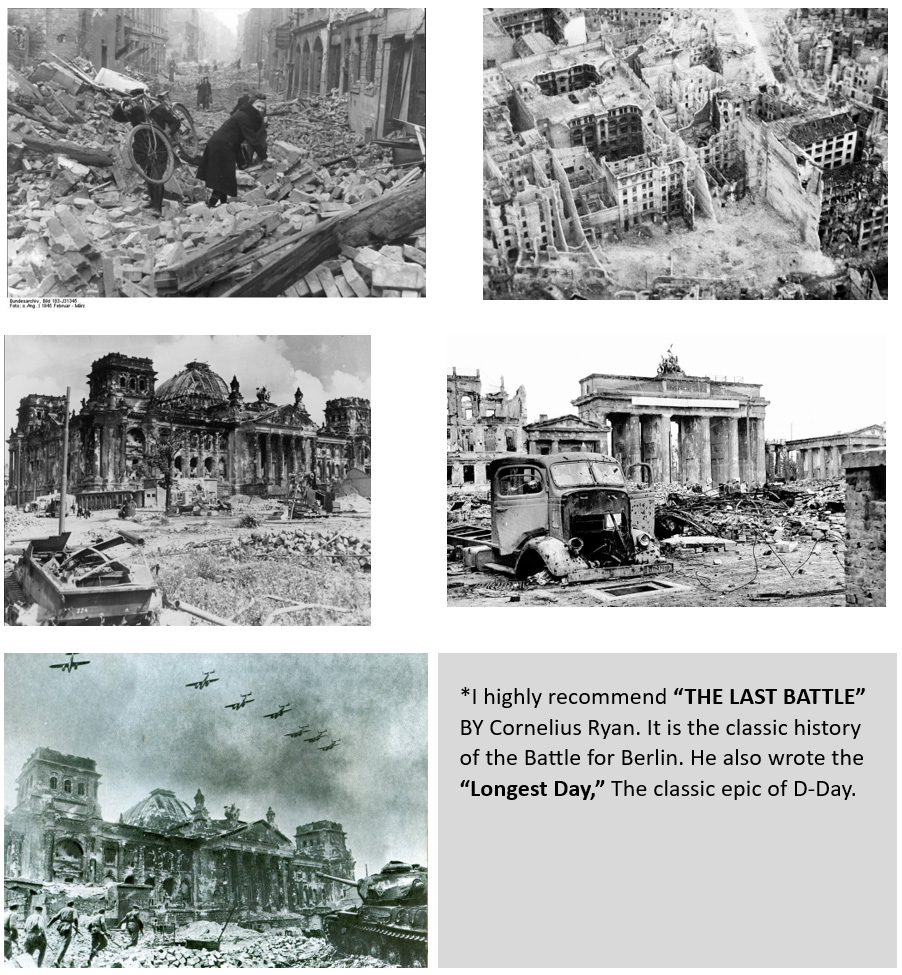
On 2 May 1945, the Berlin garrison surrendered to the Soviet army. The Battle of Berlin resulted in a devastating number of casualties. Soviet forces suffered over 80,000 killed and 280,000 wounded, while German military casualties were estimated at 92,000 to 100,000 killed and 200,000 wounded. Additionally, the battle claimed the lives of an estimated 300,000 Berlin civilians. 

berlin images

Page 39

NEXT- WORLD WAR 2 BY THE NUMBERS

Sign Up for Blog Posts

Receive New Blog Notifications.
Please enable JavaScript in your browser to complete this form.

Contact Paul Now

With your comments or questions. Whether it has been only yesterday or 50 years ago I would love to hear from you. I'll get back to you soon.
Please enable JavaScript in your browser to complete this form.
Name